


|
|
Cardinal marks are used to indicate direction that the deepest water lies around a point of interest.While cardinal marks do not have a distinctive shape (though there are normally pillar or spar), they are always painted in yellow and black horizontal bands, with their distinctive double cone top-marks always painted black. |

A way to remember their colouring is provided by using the top-marks as pointers to the positions of the black band(s):
- North - top-marks point upwards, so colours are a black band above yellow band;
- South - top-marks point downwards, so colours are black band below yellow band;
- East - top-marks point away from each other, so the black bands are above and below the yellow band; and,
- West - top-marks point towards each other, so the black band is shown with yellow bands above and below.
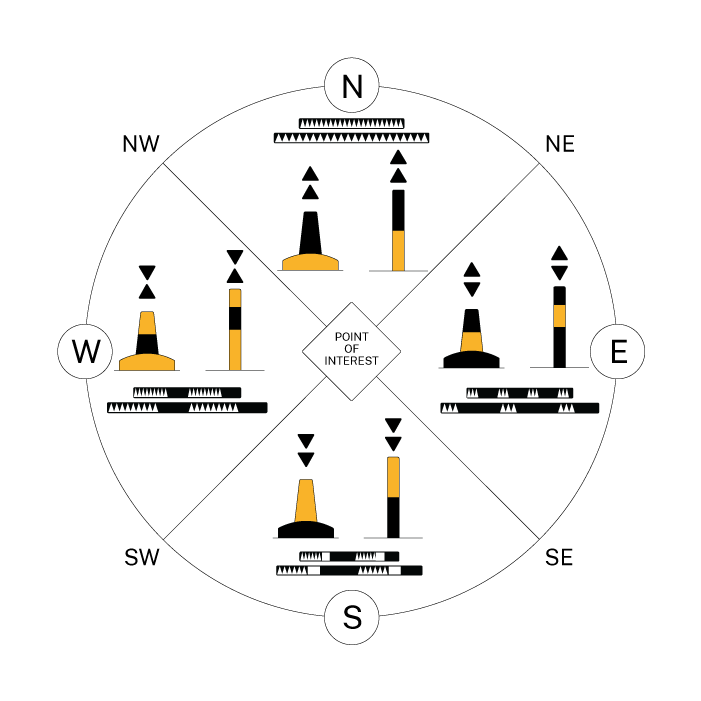
Cardinal marks also have a special system of flashing white lights. The rhythms are basically all “very quick” (VQ) or “quick” (Q) flashing but broken into varying lengths of flashing. VQ is defined as a light flashing at a rate of either 120 or 100 flashes per minute, while Q is a light flashing at either 60 or 50 flashes per minute. A long flash is also used, and is defined as a light lit for not less than 2 seconds.
The characters used for Cardinal marks lights are best remembered using the concept of a clock face, three, six, nine as follows:
N |
 |
- continuous VQ or Q flashing |
E |
 |
- three VQ or Q flashes followed by darkness |
S |
 |
- six VQ or Q flashes followed immediately by a long flash, then darkness |
W |
 |
- nine VQ or Q flashes followed by darkness. |
It should be noted that two other marks use white lights: Isolated Danger marks and Safe Water marks. Each has a distinctive light rhythm that cannot be confused with the VQ or Q flashing lights of Cardinal marks. |
|


