Introduction to Yachting / Module 5: Cultural Awareness in Guest and Crew Interactions
Lesson 1: Interacting with guests and crew from different cultures
|

|
Thumbs up means ‘good job’ right?
Find out later in this lesson.
|
|
OBJECTIVE
This lesson explores the importance and impact of diversity, equality and the different cultures and behaviours you will experience when working on yachts.
Topics covered are:
- Terminology
- Cultural diversity in the yachting industry
- Why you should be aware of cultural diversity
- Working with and serving people from different cultures
- Arriving at a new destination
|
Three key terms: diversity, inclusion and equality
Diversity
 |
Diversity encompasses a wide range of cultural backgrounds, perspectives, and experiences, enriching the
fabric of the yachting industry. Embracing diversity fosters innovation, creativity, and a positive work environment, contributing to enhanced guest satisfaction and operational
efficiency.
For example: On board a yacht, the crew includes people from South Africa, Italy, the Philippines, and Australia, each bringing different languages, traditions,
and experiences. |
Inclusion
 |
Inclusion is an action that means everyone is included within a group, workplace set-up or social circle.
People are encouraged to retain their uniqueness and are not singled out for being different. Everyone should have a sense of belonging in the team, a chance to achieve the same
outcomes as everyone else, and a strong sense of psychological safety.
An example is: At dinner, the chef makes sure everyone’s dietary needs are respected — including Halal, vegetarian, and gluten-free options — so that everyone
feels considered and welcome. |
Equality
 |
Equality ensures that all individuals are treated with fairness and respect, regardless of their cultural
background or identity. This creates a sense of belonging and inclusion for everyone onboard.
For example: Two junior deckhands, one male and one female, are given the same training opportunities and tasks, with performance judged based on skill and
ability, not gender. |
Cultural diversity in the yachting industry
The maritime industry was one of the first ways the world became connected. Ships travel to many different countries and continents to get supplies
and make repairs. As a result, crew members often interact with people from a wide range of backgrounds and work in diverse, multicultural environments.
Understanding cultural diversity is important for creating a welcoming environment, treating everyone fairly, and giving guests the best possible
experience.
Take a moment and consider!
Notice how other cultures are different from your own. Now try to imagine how others see your culture, which
is just as unfamiliar to them. There's no such thing as a neutral culture because everyone brings their own unique background and perspective.
Why is it important to understand cultural diversity?
Behaving with cultural sensitivity and awareness is paramount for fostering positive interactions, between crew members and, with guests. This
promotes strong teamwork because crew members feel respected and valued, regardless of where they come from. Communication improves and safety aspects are enhanced through
increased trust within the crew. Job satisfaction increases and conflict situations are reduced. This all ultimately results in exceptional experiences for the guests.
At the beginning of the lesson, we asked whether a thumbs-up is always a positive gesture.
|
Thumbs-up commonly means "good job" or "well done" in America and western countries, but in parts of the Middle
East and South Asia such as Bangladesh, the same gesture can be interpreted as an insult. It's like giving someone the middle finger without realizing it.
Source: Fork Union Military Academy
|
 |
While the thumbs up is widely recognised as a good hand gesture, it is a good example that what you take for granted in your culture does not always
translate to other cultures.
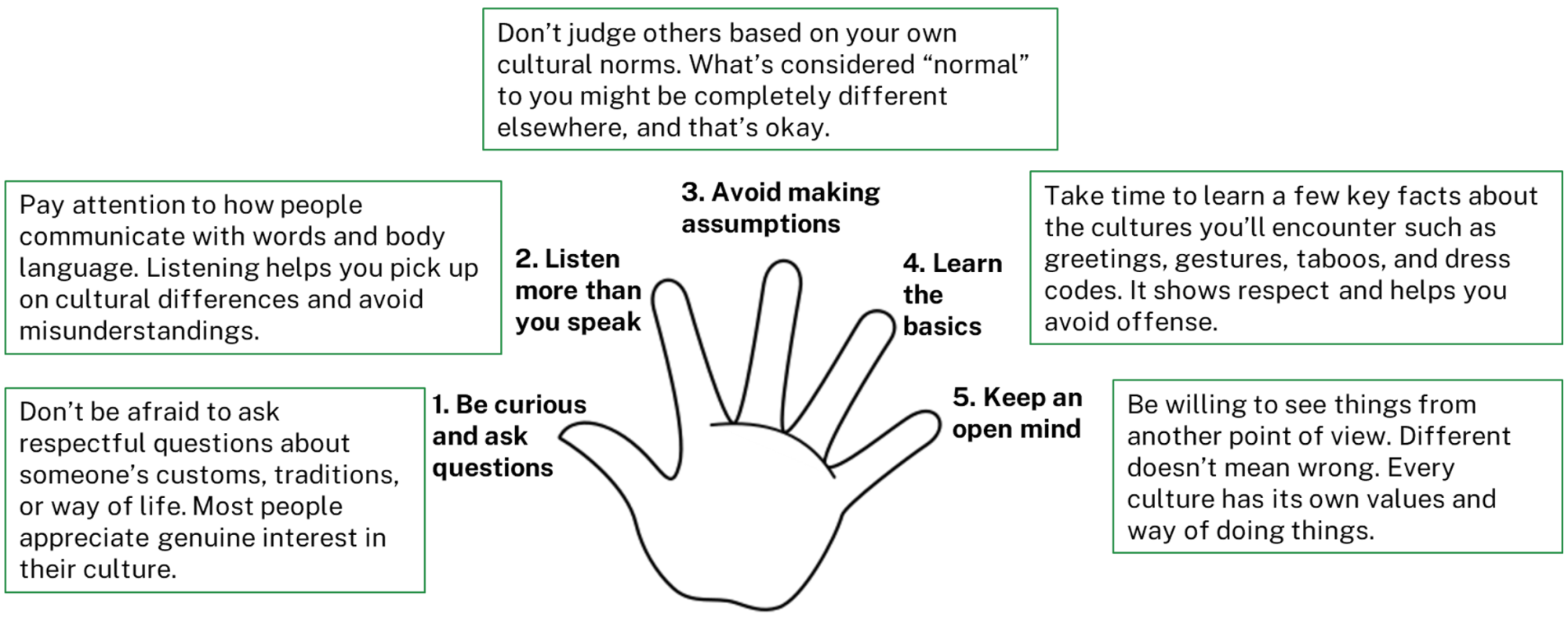
5 tips to help you understand other cultures.
Working with different cultures
Working with different cultures on board a yacht requires openness, respect, and adaptability to ensure smooth communication and strong team cohesion.
In the yachting industry, interacting with crew and guests requires different approaches, especially in a culturally diverse environment.
Cultures of the crew
Yachting is a global industry, and it is common for crew teams to be made up of individuals from many different cultural backgrounds. This diversity
can enrich the onboard experience, foster creativity, and build a dynamic team environment. However, it also requires sensitivity, clear communication, and mutual respect to
navigate differences in communication styles, attitudes toward hierarchy, timekeeping, and social behaviour. Understanding the cultures of the crew is essential for maintaining
harmony, promoting teamwork, and ensuring a positive and professional working atmosphere.
Use the table below to learn how to interact with the crew considering different cultures.
| Aspect |
Interacting with crew |
| Focus of the interaction |
Teamwork and collaboration.
E.g. Assisting a teammate with a task during a busy turnaround |
| Cultural awareness |
Respect different backgrounds and communication styles.
E.g., a crew member may avoid eye contact as a sign of respect. |
| Communication approach |
Practice open communication, active listening, and avoiding stereotypes.
E.g., check in with a colleague rather than assuming they're being rude. |
| Behavioural interpretation |
Avoid misjudging others’ behaviour.
E.g., someone may be very direct—it’s not personal, just cultural. |
| Attitude |
Cooperative, respectful, and inclusive.
E.g. Involve everyone in decisions, even if some are quiet. |
| Outcome |
Smooth teamwork and positive crew relations.
E.g. Successfully completing a docking procedure through clear communication and coordinated action. |
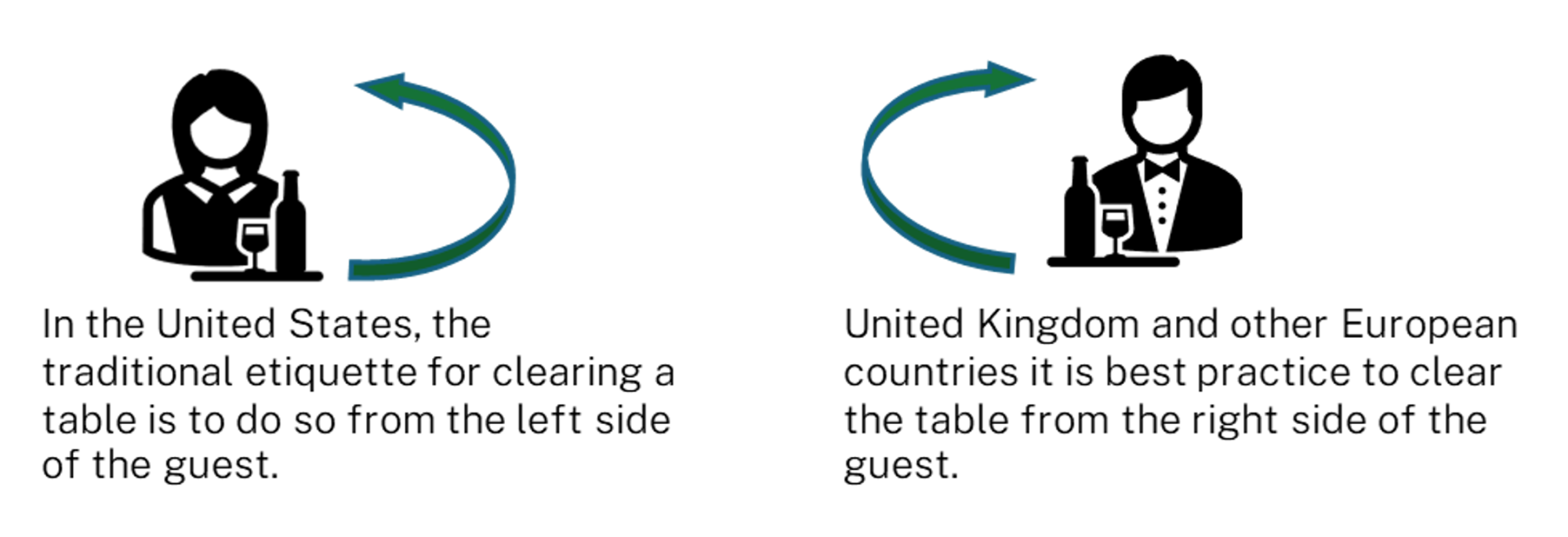
Consider culture when serving guests
When serving guests, it is important to consider their cultural backgrounds to respect their preferences and provide a more personalised and
comfortable dining experience.
For example:
Would you consider this correct or incorrect service procedure? It's not always so
clear.
Check with the Chief Stew which service protocol is appropriate for the country and the guest and service
style/protocol.
|
Use the table below to learn how to interact with guests.
| Aspect |
Interacting with guests |
| Focus of the interaction |
Providing outstanding service.
E.g. Greeting guests warmly and offering refreshments upon arrival |
| Cultural awareness |
Understand cultural preferences in service and interaction.
E.g., some guests may expect a more formal greeting, like a bow. |
| Communication approach |
Clear, polite, and humble communication; adapt to guest preferences.
E.g., avoid slang and always say “please” and “thank you.” |
| Behavioural interpretation |
Avoid assuming guest expectations are the same as yours.
E.g., don’t make physical contact like handshakes if you are unsure it's welcome. |
| Attitude |
Professional, courteous, and service-minded.
E.g., never argue or correct a guest, even if they are mistaken. |
| Outcome |
Guests feel comfortable, respected, and well cared for.
E.g. A guest compliments the service and says they felt at home on board. |
Take a moment and compare and contrast the two tables.
Learn the difference so you can excel at working with different cultures.
|
|
Arriving at a new destination
When visiting destinations, crew members should familiarise themselves with local customs, traditions, and social norms to ensure respectful
behaviour and avoid unintentional offense. For example, in Asia, touching someone on the head is regarded as highly offensive, as well as entering any religious or cultural site
improperly dressed. In Europe, it is customary for people to greet by kissing the cheek, but this usually occurs only when people are known to each other. You must make an effort
to understand the customs and cultures prior to disembarking from the vessel. Be courteous at all times.
If one of your fellow crew members comes from the arrival port, ask them about the customs and cultures.
This helps you to:
- Get first-hand knowledge, and
- Build a better connection or bond with your crew mate.
|
 |
Learning Activity: How much do you know about different cultures?
This exercise highlights the importance of learning about and respecting different cultures. You may have discovered that there’s still a lot to
learn, and that’s perfectly okay. Cultural understanding is a continuous journey. By approaching it with curiosity and respect, you will go further than simply memorising facts,
you will build stronger relationships and become more effective in diverse environments.
SUMMARY
In this lesson, we have discussed:
- The terms “diversity, inclusion and equality,”
- The role and impact of cultural diversity in the yachting industry,
- How inclusion can lead to workplace satisfaction and ultimately excellent guest experiences,
- Pointers for working with and serving people from different cultures, and
- What to do when you arrive at a new destination.