
Introduction to Yachting / Module 6: Introduction to International Maritime Law
Lesson 1: International maritime organization and maritime policies
|
|
What happens if the vessel doesn’t pay your wages?
Find out how you are protected in this lesson.
|
|
OBJECTIVE
In this lesson you learn about:
- The international maritime law and international maritime organisation (IMO)
- The four pillars that make up the IMO
- Your rights in the eyes of the law
- Health, safety and security codes
- What to do if you witness the law being broken
|
In Module 1 Lesson 3 we introduced the concept of regulations. In that lesson we focussed on port regulations and flag state registration, which are location specific. In this
lesson we take a wider look at international laws.
International Maritime Law
The sea is not owned by a single country, and vessels regularly cross international waters. Naturally, there must be a shared legal framework to:
- Ensure safety at sea
- Protect marine environments
- Prevent and resolve conflicts
- Regulate shipping practices, crew rights, and vessel standards
- Guide jurisdiction in case of crimes or accidents at sea
The International Maritime Organisation (IMO)
“IMO – the International Maritime Organization – is the United Nations specialized agency with responsible for safety and security of shipping operations. And they act to
prevent marine and atmospheric pollution by all ships. IMO's work supports the UN sustainable development goals.” – IMO website.
The IMO has four main rules, also called pillars, that help make ships safer and improve how they work. These pillars are:
| Pillar |
Convention to address pillar |
| Safety |
SOLAS (International Convention for the Safety of Life at Sea) |
| Environment |
MARPOL (International Convention for the Prevention of Pollution from Ships) |
| Training |
STCW (Standards of Training, Certification and Watchkeeping for Seafarers) |
| Working conditions |
MLC 2006 (Maritime Labour Convention) |
| All the conventions aim to continuously improve
the quality of the international maritime shipping sector by establishing uniform standards. |
These rules help protect the people who live and work on board by establishing a base line for safe
working procedures and acceptable working conditions as well as ensuring appropriate qualifications are met for all crew. An equally important aspect of the IMO is to stop
pollution and damage to the sea caused by everyday ship activities or accidents.
1. Safety of Life at Sea (SOLAS)
The safety of the crew and passengers aboard ships is one of the key concerns of the business, and SOLAS (the International Convention for the Safety of Life at Sea) is widely
regarded as the most important of all international maritime conventions. The SOLAS Convention outlines various laws and rules that explain the minimal safety requirements for
developing, outfitting, and operating commercial ships. Not all ships are covered by the SOLAS Convention. Vessels operating in international waters will be subject to the SOLAS
regulations unless they are warships, cargo ships under 500 GT, non-propelled ships, wooden ships, non-commercial pleasure yachts or fishing vessels.
2. Standards of Training, Certification, and Watchkeeping (STCW)
For all levels of staff and crew on board a ship, including masters, officers, and watch people, the STCW, or Criteria of Training, Certification, and Watchkeeping for
Seafarers, establishes basic qualifying standards.
Through a shared agreement that guarantees equivalent training programs are completed internationally by all seafarers of equal position and rank. All crew members are subject
to STCW regulations, which apply to ships over 24 meters long. Some positions require specific credentials, sea time, and refresher training.
3. The International Convention for Pollution Prevention from Ships (MARPOL)
The principal international marine convention addressing the prevention of environmental pollution by ships is called MARPOL, or the International Convention for the Prevention
of Pollution by Ships. MARPOL addresses both normal operating and unintentional pollution avoidance. The MARPOL Convention also establishes guidelines for handling, stowing, and
transporting hazardous material.
Unlike SOLAS, the MARPOL Convention applies to any vessel, regardless of flag or place of operation, flying the flag of a State that is a party to the Convention or conducting
business there. The provisions of MARPOL must be incorporated via national legislation in signatory flag states.
4. Maritime Labour Convention (MLC)
The MLC, or Maritime Labour Convention, sets minimum requirements for seafarers on ships. The MLC, referred to as the “Bill of Rights” for seafarers, covers a broad range of
issues related to working conditions at sea.
This Convention offers a single, universally regarded source of rules and direction. The MLC guarantees mariners the following basic working conditions:
- Employment Contracts - Every crew member should have a written employment contract that clearly outlines the terms of their employment, including
their job description, working hours, and remuneration.
- Working hours - The MLC mandates that crew members are not to exceed 14 hours of work in any 24-hour period, and no more than 72 hours in a seven-day
period.
- Pay - Crew are entitled to fair and timely wages.
- Levels for Manning - Each vessel must carry a minimum number of qualified crew to ensure safe and efficient operation.
- Rest Periods and Leave Rights - The MLC stipulates a minimum of two and a half days of paid leave for every month of service.
- Repatriation - All seafarers have the right to be repatriated at the end of their contract or in cases of illness or other valid reasons.
- Compensation for a Lost Ship or a Launch - Crew are entitled to compensation for lost wages and personal effects.
- Development of Career and Skills - Seafarers should have access to training and development opportunities.
Under the MLC, sailors must also be taught and qualified to undertake responsibilities when aboard, complete personal safety instruction, and adhere to rules requiring a
minimum age and medical certification. The MLC also mandates establishing a system for reporting workplace illnesses and accidents. The MLC does not cover fishing boats, warships,
and auxiliary vessels, nor are the seafarers working on ships that operate inland or in protected seas.
Why is the IMO relevant to you?
As a member of a yacht's crew, understanding maritime law is crucial because:
- You are subject to multiple jurisdictions – the flag state, the waters you sail in, and any ports you enter.
- Safety and pollution rules (like MARPOL) apply to everyday duties, including galley waste management and garbage handling.
- Training and certification requirements (e.g., STCW) are important components of international law.
- Crew contracts, hours of rest, and working conditions are protected under the MLC.
- Legal disputes, such as unpaid wages or injury claims, are governed by maritime law.
General terms of employment
Working on a yacht is not comparable to any land-based industry. Many, but not all yachts, may ask you to sign crew agreements, non-disclosure agreements and/or comprehensive
job descriptions. Crew are normally paid on a monthly basis and are rarely compensated for overtime. Many yachts offer benefit packages that can include health insurance, paid
vacations (from two to eight weeks per annum), annual flights and education allowances. Although your crew coordinator can make recommendations regarding your conditions of
employment, you are responsible for all employment-related negotiations.
What are your rights as a crew member?
Understanding your employment rights is crucial for protecting yourself, both physically and financially. It allows you to advocate for your own well-being, ensuring that you
are treated fairly and professionally. Below is a list that covers main elements, but it is not exhaustive. You have the right to:
- A Seafarer’s Employment Agreement (SEA), consistent with the standards set out in the code.
- Sufficient time to examine the SEA prior to joining the yacht with the right to seek advice prior to signing.
- The SEA to be signed by both parties before employment starts.
- The SEA should provide decent working and living conditions as set out by MLC 2006.
- Salary to be paid at monthly intervals and a monthly account of such payments to be sent.
- The maximum hours of work shall not exceed 14 hours in any 24-hour period and 72 hours in any seven-day period.
- Leave shall be calculated based on a minimum of 2.5 calendar days per month of employment.
- Crew have the right to be repatriated at no cost to themselves, under the conditions specified in the code.
- Crew will be provided with food and water free of charge during the time they are on board.
- Crew will be covered by adequate measures for the protection of your health while on board at no cost to you (the employee).
- Crew will be treated fairly in the case of disciplinary actions and shall have the freedom of communication.
- Crew will be protected from harassment and bullying and have the chance to file complaints.
Commercial yacht vs. private yachts
If you join a commercially registered yacht as a crew member, you will be protected by the MLC 2006 convention. However, if you are employed on a private yacht, it’s important
to be aware that you may not benefit from the same rights. It’s important to request a copy of the contract prior to joining the yacht to ensure that the working conditions are
safe and acceptable.
Protect yourself by knowing the law and your rights.
Health, safety and security responsibilities for employers and employees.
There are different codes, policies and regulations that support safety and security for the crew, the vessel and the environment. It is important to know and understand how
these codes work together to protect you.
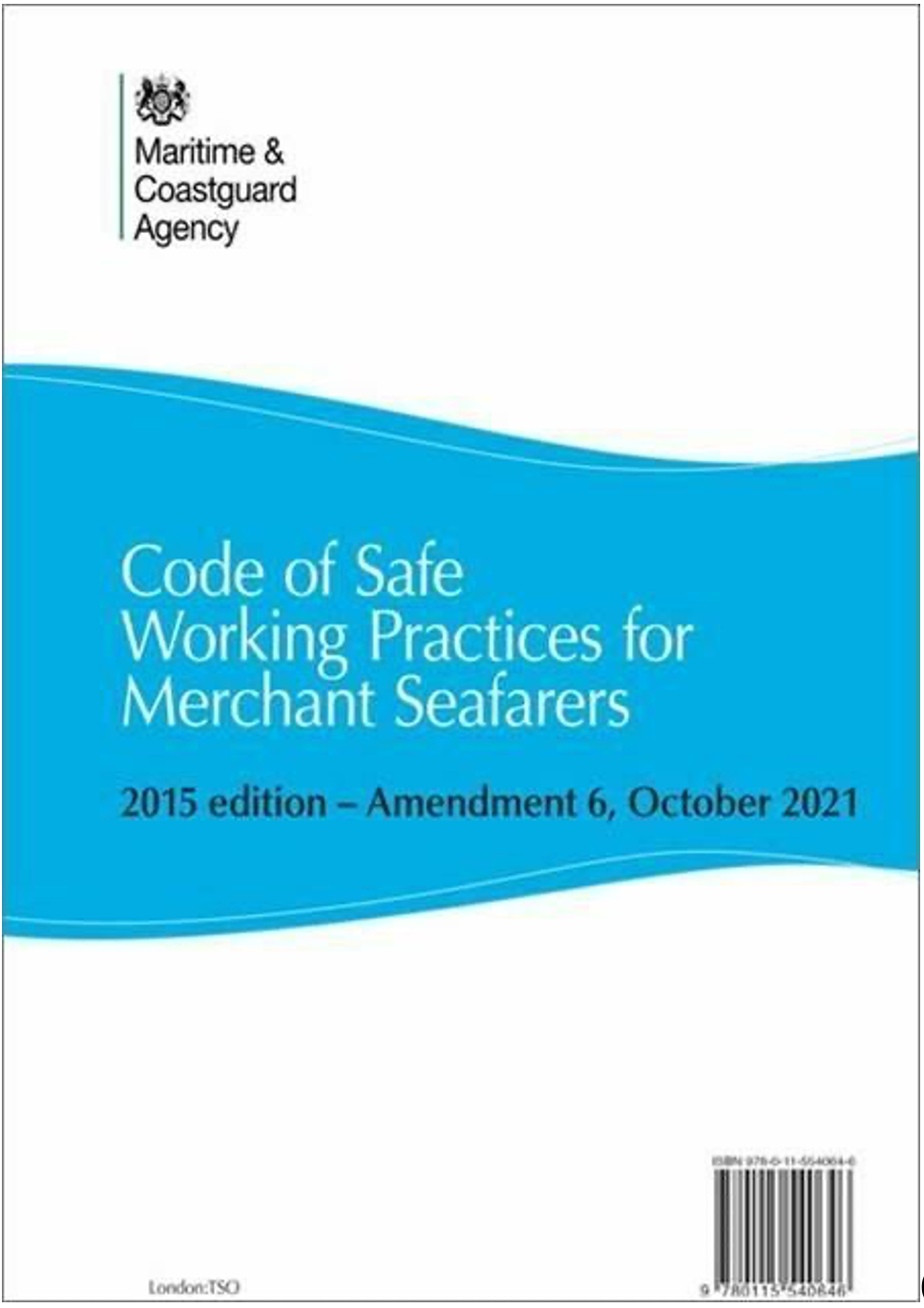 |
COSWP:
COSWP stands for the Code of Safe Working Practices for Merchant Seafarers. This code is designed for merchant vessels registered in the United Kingdom, but its
principles are widely adopted in the yachting industry to promote safety and compliance. It is addressed to both those on a ship (regardless of rank or rating) as well as
shore-based staff with safety responsibilities.
|
Seven key areas:
- Health and Safety Responsibilities
- Everyone has a duty to take care of themselves and others.
- Employers must provide safe systems of work and proper training.
- Risk Assessment
- Hazards must be identified, and measures put in place to reduce risk.
- Working at Height
- Safety harnesses, proper equipment, and training are essential.
- Enclosed Spaces
- Entry into confined areas must follow strict procedures to avoid accidents.
- Manual Handling
- Safe techniques to prevent back and muscular injuries.
- Personal Protective Equipment (PPE)
- Proper use of gear such as gloves, helmets, and safety boots.
- Emergency Procedures
- Includes drills for fire, abandon ship, man overboard, and more.
A vessel that follows the COSWP code is committed to safety and professional standards. Crew who follows COSWP gain the right
reputation.
COSHH:
Control of Substances Hazardous to Health (COSHH) Regulations 2002 (as amended) is a UK regulation that requires employers to
control exposure to hazardous substances that can cause ill health to workers. Employers should:
- Assess the risks that arise from the use of hazardous substances. This will include any arrangements to deal
with accidents, incidents or emergencies, such as those resulting from serious spillages. The assessment must also include the health and safety risks arising from storage,
handling or disposal of any of the substances.
- Prevent, or if this is not reasonably practicable, control exposure to
such substances.
- Provide staff with information, instruction and training about the risks, steps and precautions the employer
has taken to control these risks, for example, using appropriate rubber gloves or appropriate eye protection.
Material Safety Data Sheets (MSDS)
A material safety data sheet (MSDS) outlines the hazards associated with substances and mixtures, and offers guidance on their safe
handling and use.
Material Safety Data Sheets (MSDS), also known as
Safety Data Sheets (SDS)
communicate information on properties and hazards of substances and mixtures, recommendations for safe handling and use, requirements for storage and transport, and measures for
first aid, accidental releases, exposure control and personal protection.
There are typically 15 sections in an MSDS that details the relevant information about the material.

Example of section 2: Hazard identification.
|
- Product Identification
- Hazard Identification
- Composition/Information on Ingredients
- First Aid Measures
- Fire-Fighting Measures
- Accidental Release Measures
- Handling and Storage
- Exposure Controls/Personal Protection
- Physical and Chemical Properties
- Stability and Reactivity
- Toxicological Information
- Ecological Information
- Disposal Considerations
- Transport Information
- Regulatory Information
|
The 8 principles of COSHH are:
- Ensure control measures do not increase overall risk to health and safety.
- Design and operate processes to minimise the release and spread of hazardous substances.
- Consider all relevant routes of exposure – inhalation, skin, and ingestion.
- Control exposure by measures that are proportionate to the health risk.
- Choose the most effective and reliable control options that minimise the escape and spread of substances.
- Use personal protective equipment (PPE) only as a last resort for controlling a hazard.
- Check and review regularly all elements of control measures for effectiveness.
- Provide suitable information, instruction, and training to employees.
International Ship and Port Facility Security (ISPS) Code
The
ISPS Code is a set of measures to enhance the security of ships and port facilities. It was developed in response of the perceived
threats to ships and port facilities after the 9/11 attacks. The ISPS Code is part of the Safety of Life at Sea Convention (SOLAS) and compliance is mandatory for the 148
Contracting Parties to SOLAS.
Safeguarding and child protection policies
Safeguarding and child protection procedures are detailed guidelines and instructions that support your overarching safeguarding policy statement. They explain the steps that your
organisation will take to keep children and young people safe and what to do when there are concerns about a child's safety or wellbeing.
For example, your safeguarding procedures should cover issues like how staff and volunteers should respond to concerns about a child and young person and how you will make sure
you recruit the right people to work with children and young people.
Learning Activity: Do you know the law?
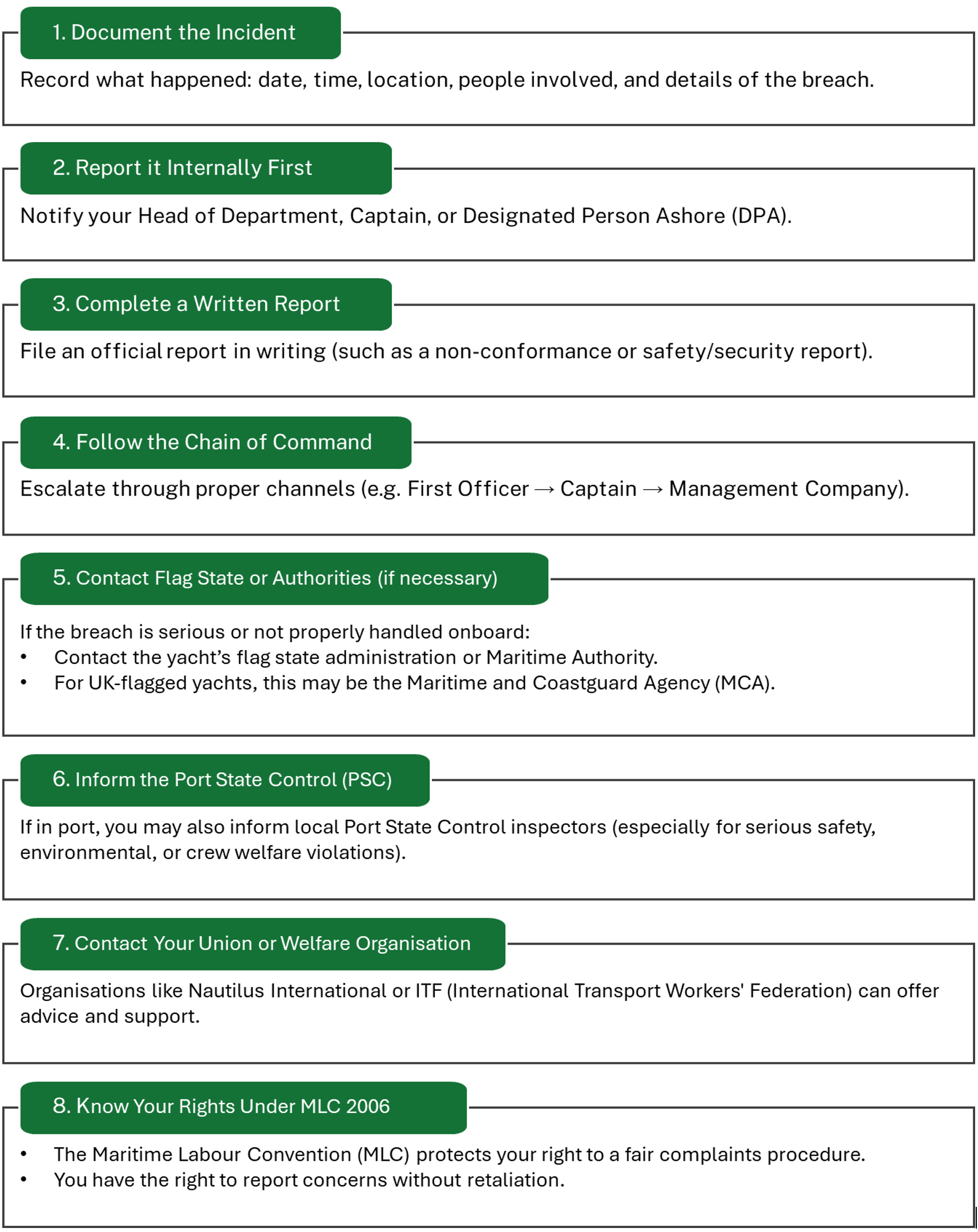
Should you do something when there is a breach in the law?
Certainly! If there is a breach in maritime law, whether it's related to crew rights, safety, pollution, or vessel operations, it's important to follow a clear and professional
process.
Here are the steps you should take if you suspect or witness a breach in maritime law:
SUMMARY
In this lesson, we have covered elements of the maritime law for all those at sea. This included:
- International maritime law and the international maritime organisation (IMO)
- The four pillars that make up the IMO are SOLAS, STCW, MARPOL, MLC
- Your rights and how you can protect yourself
- COSWP, COSHH and ISPS that keep you, the vessel and our environment safe.
- Steps to take if you notice that laws have been broken.


